Lead Generation
Where Do Contractors Find Leads? The Five Main Sources, Compared
The five places home service contractors get leads, how each one works, what it costs you and how to compare them on booked jobs rather than clicks.
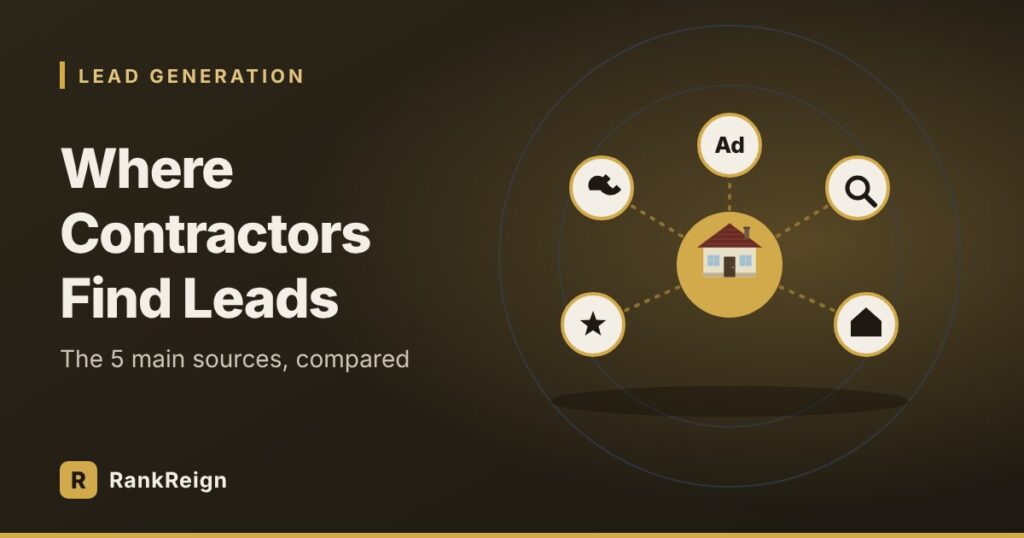
Most contractors get leads from five places. Referrals, lead marketplaces, Google Local Services Ads, paid search, and their own website and local search presence. This guide answers one question: where do contractors find leads?
Each one behaves differently. They cost different amounts, they arrive at different speeds, and they are worth different amounts once the job is booked. Here is how each one works, and how to compare them without fooling yourself.
Referrals and repeat customers
This is still the best source of work for most contractors. The lead is warm, the homeowner already trusts you, and you rarely compete on price.
The problem is volume. Referrals arrive when they arrive. You cannot turn them up in a slow month, and you cannot plan a hiring decision around them.
Treat referrals as your base, not your plan. Ask for them properly, make it easy to leave a review, and stay in touch with past customers. Then build something you can control on top of that.
Lead marketplaces
Angi, Thumbtack, HomeAdvisor, Porch and similar platforms sell you contact details for homeowners who filled in a form.
The mechanics matter. On most of these platforms the same lead is sold to several contractors at once. You are buying a shared lead. That means you are competing on response speed and on price, often with three or four other companies who got the same phone number at the same minute.
Shared leads are cheaper per lead than most other sources. They are not always cheaper per booked job. If you win one job in ten shared leads, the cost per booked job can be higher than a source that looked expensive up front.
Two things make marketplaces work when they work. Answer within minutes, not hours. And track what you actually close, not what you receive. We wrote about the difference in exclusive versus shared leads.
Google Local Services Ads
Local Services Ads sit at the very top of Google, above the regular ads, with the Google Guaranteed or Google Screened badge. You pay per lead rather than per click.
To run them you have to pass a license and insurance check. That check is a barrier, and it is also the point. It filters out companies that cannot clear it.
The leads are usually high intent. Someone searching for an emergency plumber and tapping the top result is ready to book. The budget is set by the number of leads you want rather than a click bid, which makes planning simpler.
Two cautions. You can be charged for leads that turn out to be the wrong job type or the wrong area, so dispute the ones that do not qualify. And your ranking depends heavily on reviews and response rate, so the account needs attention, not just funding.
More on how we run these: Google Ads and Local Services Ads.
Paid search
Standard Google Ads, where you bid on searches like “roof replacement” plus your city and pay per click.
Paid search gives you the most control of any source. You choose the services, the areas, the hours and the message. You can turn it up before a slow season and down when the schedule is full.
It is also the easiest place to waste money. You pay for the click whether or not the phone rings. Broad keywords, no negative keywords and a slow website will burn a budget fast.
Paid search works when the landing page matches the search and the tracking is honest. If you cannot tell which keyword produced a booked job, you are guessing.
Your own website and local search presence
This is the slowest source to build and the only one you own.
It covers your Google Business Profile, your map pack visibility, your service and area pages, and your reviews. When it works, a homeowner searches for your trade near them, finds you, and calls. There is no cost per lead on that call.
The trade off is time. Local SEO does not produce leads next week. It compounds over months. The contractors who are glad they started are the ones who started a year ago.
See local SEO for contractors for what that work involves.
How to compare them properly
Most contractors compare sources on cost per lead. That is the wrong number, because a lead is not a job.
Compare on cost per booked job instead. For each source, you need three things:
- What you spent on it
- How many enquiries it produced
- How many of those became signed work
Divide the spend by the booked jobs. Now you can see which source is actually cheapest. A source at a high cost per lead that closes one in three can easily beat a cheap source that closes one in twelve.
You cannot do this from memory. It needs call tracking, so every enquiry carries its source, and a simple record of what happened to each one. That is what lead tracking and CRM follow-up is for.
Our longer piece on the arithmetic is here: how to calculate cost per qualified lead.
Where to start
If you have nothing running, start with the two that produce work soonest. Get your Google Business Profile in order, and run Local Services Ads if you can pass the check.
Then build the owned side underneath it, so that in a year you are not renting every lead you get.
And track everything from day one. The tracking is what tells you which of these five to spend more on next quarter, and that decision is worth more than any single campaign.
Want a look at where your leads come from today? Book a strategy call.
Where do contractors find leads: frequently asked questions
Where do contractors get leads?
Most home service contractors get leads from five places: referrals and repeat customers, lead marketplaces, Google Local Services Ads, paid search, and their own website and local search presence such as Google Business Profile.
Which source of contractor leads is best?
It depends on your trade and market, so compare each source on cost per booked job rather than cost per lead. That needs call tracking so every enquiry carries its source.
Are Local Services Ads worth it for contractors?
Often, yes. They appear at the top of Google, charge per lead and require a license and insurance check. They work best with good reviews, fast responses and a tracked follow-up process.
Keep Reading
How Much Do Exclusive Contractor Leads Cost? Compare by Booked Job
Lead prices by trade, how platforms charge and how to judge exclusive leads by cost per booked job, with a worked example.

Windows and Doors Marketing: Get Quote Requests, Not Tire-Kickers
How window and door companies attract serious quote requests: honest pricing, installation proof, local search and a 60-day follow-up.
Water Damage Restoration Marketing: How to Win the First Call
Restoration jobs go to the company that answers first. How to be answerable, visible and trusted when a homeowner is in a crisis.
Ready to Own Your Market?
Book a strategy call. We will look at how enquiries reach your business today and where the system leaks, then give you a straight recommendation.